
Prologue
The Treaty of Gandamak
Signed 26 May 1879 by the emir of Afghanistan, Mohammad Yaqub Khan and Sir Pierre Louis Napoleon Cavagnari it was the official end of the Second Anglo-Afghan War. The Second Anglo-Afghan War began as a repercussion to the Great Game. After tensions between Russia and the British Empire ended officially at The Berlin Conference of 1878 Russia turned its attention to its other frontiers. On the 22 July 1878 a Russian envoy arrived uninvited into Kabul. On the 14 August the British Empire demanded that Amir Sher Ali accept an envoy too. Sher Ali response was not to only refuse this request, but to stop it if any attempt was made to enter Afghanistan. In September 1878 a British Mission was sent and at the order of Lord Lytton, the Viceroy of India. As it neared the eastern entrance of the Khyber Pass it was stopped and turned back. This event triggered the Second Anglo-Afghan War. A British Force of 40,000 made up of Indian and British soldiers attacked Afghanistan from three different points. They made a rapid progress and occupied much of the country. The Sher Ali appealed to the Tsar of Russia, but failed to gain any support and three months later died of natural causes. His son Mohammad Yaqub Khan assumed control of the nation and signed the treaty a month later. It is widely regarded as the most humiliating treaty ever signed by an Afghan Ruler, it made Afghanistan a puppet of Britain in everything, but name.
-Mohammad Yaqub Khan with Britain's Sir Pierre Cavagnari
As part of the treaty a British Mission was to be placed permanently in Kabul, taking control over Afghanistan’s Foreign policies. Less than two months since the signing of the treaty a dissatisfied regiment of the Amir’s Army stormed the Missions compound. The Mission headed by Sir Pierre Cavagnari and his staff were massacred, starting the Second stage of the war. Major General Sir Frederick Roberts led what would later be known as the Kabul Field Force across the Shutargardan Pass and defeated the Afghan Army that awaited him and occupied Kabul on the 6 October 1979. With the lack of any sizable resistance Yaqub Khan was forced to the peace table. Due to his suspected complicity in the massacre of Cavagnari he was obliged to abdicate the throne. Yaqub Khan chose to pass his throne onto his cousin Abdur Rahman who resigned The Treaty of Gandamak, but with a single alteration. There would be no British Mission in Afghanistan. With all other objectives achieved the British agreed and the Second Anglo-Afghan War ended.
"His Highness the Amir of Afghanistan and its depen-dencies engages, on the exchange of the ratifications of this Treaty, to publish a full and complete amnesty, absolving all his subjects from any responsibility for intercourse with the British forces during the war, and to guarantee and protect all persons of whatever degree from any punishment or molestation on that account.
His Highness the Amir of Afghanistan and its depen-dencies agrees to conduct his relations with Foreign States in accordance with the advice and wishes of the British Government. His Highness the Amir will enter into no engagements with Foreign States, and will not take up arms against any Foreign State, except with the concurrence of the British Government. On these conditions the British Government will support the Amir against any foreign aggression with money, arms, or troops, to be employed in whatsoever manner the British Government may judge best for this purpose. Should British troops at any time enter Afghanistan for the purpose of repelling foreign aggression, they will return to their stations in British territory as soon as the object for which they entered has been accomplished."
-First Section of the Gandamak Treaty. Included in the treaty was the transfer of Jurisdiction over the Korram and Pishin valleys, the Sibi district, and the Khaybar pass to the British.
The Third Anglo-Afghan War
Under the rule of Abdur Rahman Khan, Afghanistan and the British Empire went through a forty year period of reasonably good relations. Unfortunately it would be his death in 1901 that would lead to another war, eighteen years later. His successor Habibullah Khan was an unstable and unreliable leader who would side with either Britain or Russia depending on who would pay the highest price. Though Habibullah felt considerable resentment over the Convention of St. Petersburg he chose to remain the neutral in First World War. The Convention of St. Petersburg was a treaty that solidified the boundaries of control in Persia, Afghanistan and Tibet. A consequence of this treaty was that Afghanistan was to be considered a British Protectorate and that Russia was not to send any diplomats to the nation. While remaining neutral Habibullah did accept a Turkish-German mission in Kabul. During this time he resisted numerous requests for assistance from the Central Powers, instead be used both sides to benefit his position. The Turkish-German mission left in 1916 having failed to convince Habibullah to side with them. They did convince him though that Afghanistan was an independent nation in its own right and should be beholden to no one. With the end of the First World War Habibullah sought to gain reward for Afghanistan’s assistance with independence, even going as far to demand a position at the Versailles Peace Conference of 1919. The request was denied by the viceroy, but further discussions were planned. Unfortunately these never happened as on the 19 February 1919 was assassinated.

-Nasrllah Khan brother to Habibullah, left. Amānullāh Khān third son of Habibullah, right.
In the resulting power struggle two men vied for control. Habibullah’s brother Nasrullah Khan who had proclaimed himself as Habibullah's successor, and Habibullah’s third son Amānullāh Khān who also proclaimed himself Amir. While this matter could have been decided quickly with the chain of succession, the Afghan army suspected Amanullah of complicity in the death of his father and would not declare their support. Needing a way of cementing his power, upon seizing the throne in April 1919, Amanullah presented himself as a man of democratic ideals, promising reforms in the system of government. He stated that there should be no forced labour, tyranny or oppression, that Afghanistan should be free and independent and no longer bound by the Treaty of Gandamak. With this support he seized the throne and removed his uncle, sentencing him to life imprisonment for the murder of his father. While the support for his promised reforms had allowed him to seize the throne his uncle had represented a large conservative support, one that now threatened to undermine his government. His solution came from the most unlikely of sources. On Sunder 13 April 1919, Brigadier-General Reginald E.H. Dyer marched fifty men to a raised river bank overlooking a crowd of 15,000 – 20,000 and opened fire. Dyer kept continual fire for more than ten minutes. This would later become known as the Amritsar massacre. Official figures place the number at anywhere between 350 – 1000 killed with almost 1500 believed injured. This massacre caused unrest throughout India and with the weakened state of Britain’s forces following the end of the war, Amanullah found a way to unify his people. On the 3 May 1919, he invaded India.
The Afghan army was not very formidable. With only 50,000 men in strength and with officers that lacked any real training. Their equipment was also a mix of whatever was available with reports putting them with a selection of German, Turkish, Russia and British equipment. Added to this force were the 20,000 – 30,000 tribal warriors that Amanullah expected to gather in the Khyber Pass alone. Against this force the British on paper fielded a much larger army and with better equipment. In reality though, the British Indian Army was severely undermanned with several divisions in Europe and those that were in India in a process of demobilisation. The machine guns available were out-dated, artillery was in short supply and the public’s opinion for another war was low. In the favour of the British Empire though was a modern RAF, Armoured Cars and Motor transport. The war began with the seizing of the Khyber Pass and the strategically important town of Bagh. Bagh importance to the Indian and British forces, as it supplied water for two companies of soldiers in the region, the closest forces to the Afghan invasion. The Viceroy of India, Lord Chelmsford immediately began to mobilise his forces, but until he was finished there would be only one battalion available, the 2nd Battalion, Somerset Light Infantry. On the 7 May the Battalion was sent to the engage the Afghan Army at the Khyber Pass. During this time the two companies closest to Bagh grew to Brigade strength with the arrival of the 1st Infantry Brigade under Brigadier G.D. Crocker. On the 9 May Crocker ordered an attack on Bagh. The attack failed though when to protect his flank Crocker split his forces in two. Without the concentration of force he failed to capture the town and was forced to fall back. On the 11 May a second assault was made, this time with almost double the amount of British soldiers. After several hours use of 22 artillery pieces, the British army charged the Afghan position with fixed bayonets. Against this onslaught the garrisoned Afghan forces were routed from the town. Their retreat was made more pressing due to RAF bombardment. As the retreating army made it across the border their British pursuers were fired upon from the mountains and forced to give up the chase. Casualties for what would be later known as the Second battle for Bagh were 100 Afghans killed, with 300 wounded, while the British in comparison lost, 8 men killed and 37 wounded.
On the 13 May the British Army choose to cross the border and took control of Western Khyber and Dacca provinces. The British Camp however was poorly sited for defence and as a consequence they came under an intense long range bombardment from Afghan Artillery. This was followed by an infantry assault. The assault was defeated and the British counter attacked, but already stretched and exhausted from the Afghan assault failed to consolidate their position. On the 17 May the area was finally secure. The previous day the British army launched an assault on what was nicknamed the Stonehenge Ridge. The attack went on throughout the day until late in the afternoon the 11th Sikh infantry reached the top of the ridge. Once there they discovered the Afghan forces had abandoned the position leaving behind equipment, standards and artillery pieces. While the British army had achieved two very important victories it soon became apparent that a new threat to the rear was emerging. The entirety of the Khyber Rifles began to become disaffected by the situation and began to desert en masse. As a result, it was decided to disarm and disband the regiment in an effort to stop the spread of similar sentiment to other regiments. Following this Lord Chelmsford decided that the situation could be resolved by continuing the advance further into Afghanistan and gave the order for the brigade in Dacca to march towards Jalalabad, however, this order was unable to be carried out as fighting broke out further to the south and in the eastern Khyber. The situation grew worse for the British, even going as far to abandon posts around the Kurram Valley. In response the British launched bombing raids on the region and Kabul, but it did little to stem the tide.

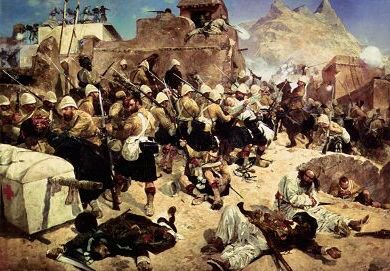
-92nd Highlanders in the battle for Quetta.
On 27 May the British attacked and captured the province of Quetta and in doing so gained the initiative in the south, the situation in Kurram, the centre of the warzone, remained dire. The Afghan forces in this area were under the command of General Nadir Khan who’s forces outnumbered the British presence by more than four too one. Matters became even worse when it became apparent that North Waziristan Militia protecting a flank was becoming disaffected. Concerned that they would rise against him and cause others to do so, Brigadier General Alexander Eustace ordered that the militia outposts be abandoned. This action ended up causing mass desertion and even caused the South Waziristan Militia to become disaffected. The militia based in Wana turned on their officers and any men who had remained loyal and attacked them. The survivors, under Major Russell, the commandant, were forced to fight their way out to a column of the North Zhob Militia which had been sent out to relieve them. With the situation deteriorating Nadir Khan took the opportunity to Thal. The posts nearing the fort had been abandoned days before. On the night of 28 May a group of men under his command seized control a tower fifty meters from the fort and managed to set fire to several food dumps. The situation for the men at the fort was bad beforehand, but now it was considered dire. Eustace's forces were outnumbered, outgunned and outclassed. He possessed no regular British infantry and his four battalions were all inexperienced Indian units, consisting mainly of young and inexperienced forces. As a result the 16th Infantry Division was ordered to relive Eustace's forces in Kurram. The division was spilt in two, part of it to cover the defence of their supply lines while the 45th Infantry Brigade under Brigadier General Reginald Dyer would carry on to Thal. Possessing no transport Dyer was forced to march his men across the landscape. Despite the conditions Dyre made good progress and on the 1 June he encountered a large force of tribesman that barred both the south and north approaches to Thal. In a move that would make him a hero he spilt his forces in two and attacked both entrances. Unable to withstand this attack the tribesman withdrew and Eustace’s forces were finally relieved. The war would carry on for another month, until Nadir Khan received a message from Amanullah requesting a cease fire. It was not until 8 August 1919 that the settlement was finally concluded when the Treaty of Rawalpindi was signed.
While the war was declared a victory for The British Empire, in reality it is more complicated. The British army achieved it objectives at the cost of almost twice as many soldiers. The outcome for Afghanistan was that it effectively gained independence. The British lost any and all control over Afghanistan and the tribesman that fought with the British felt betrayed leading to unrest and trouble along the India frontier for years to come. This has not been the only effect of the war though. Amanullah had only bought peace for a short amount of time. After Amānullāh travelled to Europe in late 1927, opposition to his rule increased. An uprising in Jalalabad culminated in a march to the capital, and much of the army deserted rather than resist. In early 1929, Amanullah abdicated and went into temporary exile in then British India. His brother Inayatullah Khan became the next king of Afghanistan for a few days until Habibullah Kalakani took over. However, Kalakani's nine months rule was soon replaced by Nadir Khan on October 13, 1929. Amanullah Khan attempted to return to Afghanistan, but he had little support from the people. From British India, the ex-king travelled to Europe and settled in Italy, and later in Switzerland. Meanwhile, Nadir Khan made sure his return to Afghanistan was impossible by engaging in a propaganda war. Nadir Khan accused Amanullah Khan of kufr with his pro-western policies.

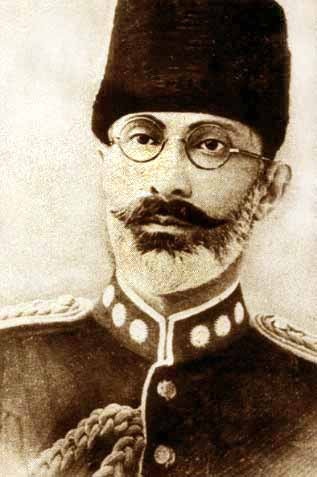
-Nadir Shan
One Mohammed Nadir Shah’s first actions as King was to remove many of the reforms Amanullah placed, with his focus being on rebuilding the nation’s army. Unfortunately while he struggled to rebuild his nation’s forces, the religious and tribal leaders’ forces did. In 1930 the country was gripped with rebellion, two rebellions in Kabul followed by two uprisings by the Pashtun Shinwari tribes. All of these were barely put down by Nadir Shan’s forces. In that same year a Soviet force crossed the border in pursuit of an Uzbek leader whose forces had been harassing the Soviets from his sanctuary in Afghanistan. He was eventually driven back to the Soviet side by the Afghan army in April 1930, and by the end of 1931 most uprisings had been subdued. What followed was two years of relative peace. During this time Nadir began improving Afghanistan in less obtrusive ways than Amanullah. He improved the road networks, creating the Great North Road through the Hindu Kush, established permanent lines of communication, established Afghanistan’s first university, funded prominent entrepreneurs to set up private business, created a banking system and a long term economic plan for the country. While his plans on increasing the army never bore fruit in his life time, after his death the national army grew from almost nothing to 40,000 in strength. On November 8, 1933, Nadir Shah was shot and killed by a teenager named Abdul Khaliq Hazara during a high school graduation ceremony. Khaliq Hazara was apprehended immediately after the assassination and was later executed along with members of his family.
Mohammed Zahir Shah. Zahir Shan was proclaimed King on 8 November 1933 at the age of 19, after his assassination of his father. He has followed the plan set out by his father. He has encouraged the growth of industry and the army, but now is the time for him to take control. Afghanistan has for almost 100 years remained a buffer state between the powers of the British Empire and the Russia. Now the British Empire is in decline, the USSR has it’s attentions fixed to Europe where the rise of a new power friendly to Afghanistan’s cause is set to usher in the new age. It’s time to see if Afghanistan can change history.

-Mohammed Zahir Shah
Authors Note:
A long time ago I started an aar called “Changing History...Just a little - A 1936 Afghanistan AAR”, in the end I abandoned it due to work reasons. I’ve been planning to knock this off my list to do for a while now. So here it is. Expect updates when I can get them. Hope you enjoy.